
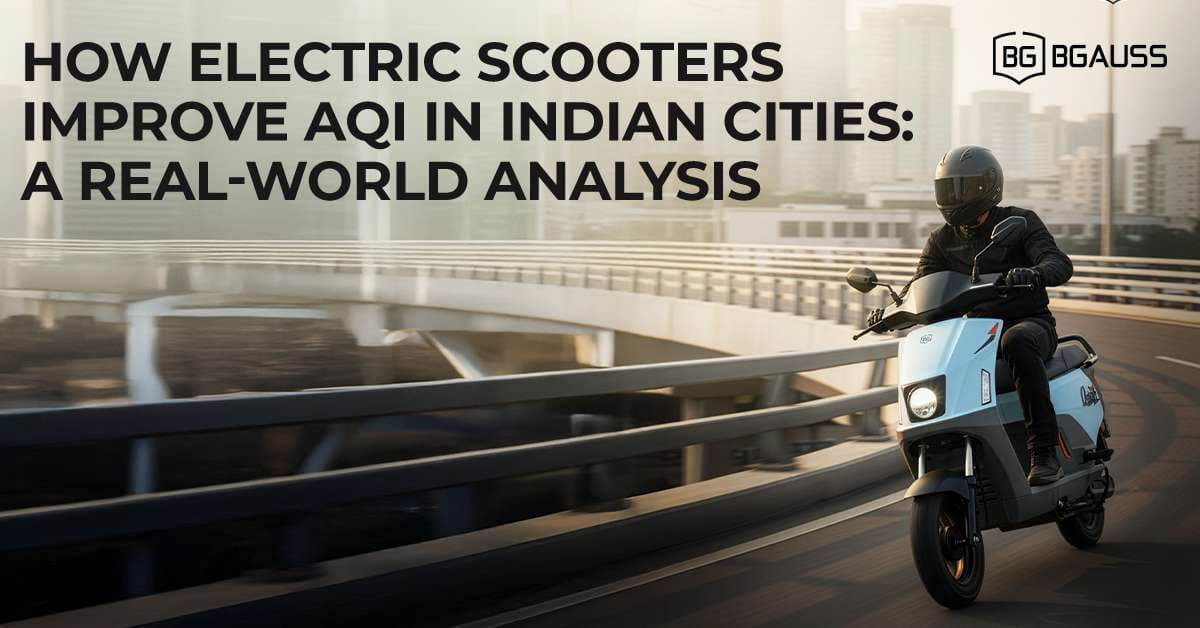
How Electric Scooters Improve AQI in Indian Cities: A Real-World Analysis
Introduction
Poor AQI in Indian Cities isn’t just an abstract statistic; it’s a health crisis affecting millions of people. Urban air pollution is primarily driven by vehicle emissions, particularly nitrogen oxides (NOx), carbon monoxide (CO), volatile organic compounds (VOCs), and fine particulate matter (PM2.5) from combustion engines. The shift to electric scooters interrupts this chain at the source, meaning fewer pollutants are emitted where people live and breathe. In this blog, we go beyond claims to explain how electric scooters change the pollution equation, with facts on emissions, lifecycle impacts, and measurable air quality improvements.
1. The Science of Urban Air Pollution
In cities like Delhi, Bengaluru, and Mumbai, tailpipe emissions from internal combustion engine (ICE) vehicles (petrol and diesel) are among the largest contributors to poor AQI, especially NOx and PM2.5, which penetrate deep into the lungs and bloodstream. Levels of these pollutants are directly linked with respiratory and cardiovascular diseases. The AQI is a composite index that accounts for these harmful pollutants, and reducing emissions at their source is the most direct way to lower AQI.
2. How Electric Scooters Eliminate Tailpipe Pollutants
Petrol scooters emit NOx, CO, and hydrocarbons every time the engine burns fuel. Electric scooters, on the other hand, have no combustion engine; they run entirely on electric motors powered by batteries. This means:
- Zero tailpipe emissions at the point of use
- No exhaust of NOx, CO, VOCs, or PM from fuel combustion
- Reduced particulate emissions because of regenerative braking, which decreases brake wear particulates compared to conventional brakes.
With zero direct tailpipe pollutants, electric scooters remove a key source of local air pollution in urban traffic where scooter usage is high.
3. What Happens When Tailpipe Emissions Go to Zero
Once tailpipe emissions are eliminated:
Nitrogen dioxide (NO2) and PM2.5 are major drivers of health-hazardous AQI spikes in Indian cities. Across studies of EV adoption in dense urban areas, increases in electric vehicle usage correspond with significant decreases in NO2 and PM2.5 concentrations, the two most toxic urban pollutants.
- Secondary Pollution Reductions Follow
Pollutants from combustion also undergo chemical reactions in the air to form secondary particles (like ozone). Reducing emissions at the source decreases these transformations. Over time, this lowers the overall pollution burden in densely trafficked city zones.
A regional study shows that e-scooter is making your city environment friendly because electric vehicle charging demand increased by 30% and cities are experiencing a measurable decline in local air pollution indicators even before grid decarbonisation becomes dominant.
4. The Lifecycle Perspective Beyond Tailpipes
Critics sometimes argue that electric vehicles are “not zero emissions” because electricity generation and manufacturing have environmental footprints. While it’s true that battery production and coal-based electricity contribute to upstream emissions, multiple life cycle assessments still find that:
- EVs (including scooters) typically produce significantly less carbon emissions over their operational life compared to petrol vehicles; some estimates show up to ~30–40% lower lifecycle emissions even on coal-heavy grids.
- Other analyses find that electric two-wheelers reduce operational emission impacts compared with ICE scooters, even when factoring in manufacturing impacts.
This means that while electric scooters are not perfect, their real-world use phase leads to lower total emissions exposed to urban populations, directly improving air quality.
5. Electric Scooters and Urban AQI: How It Shows Up in Cities
We can’t yet point to a city where electric scooter benefits alone “fixed” AQI atmospheric chemistry, and multiple pollution sources make that complex, but large-scale EV adoption does correlate with air quality improvements:
- A study modelling India’s transport electrification found that as the share of EVs grows, exposure to PM2.5 drops and resulting health impacts decrease, especially if paired with cleaner electricity.
- Real-world policy actions, such as EV incentives and transport electrification programs, are explicitly targeted at AQI improvement because traditional vehicles contribute heavily to pollution loads.
6. Concrete Mechanisms by Which Electric Scooters Improve AQI
Here’s the clearest cause-and-effect chain:
- Petrol scooter pollution and bikes emit NOx, CO, VOCs, and PM, all key AQI contributors.
- Electric scooters emit none of these at the point of use.
- As more combustion scooter pollution is replaced, the net urban emissions load declines.
- Lower emissions lead to lower ambient pollutant concentrations over time, especially in congested corridors.
- Reduced concentrations of NO2 and PM2.5 translate to improved AQI readings and lower health risks.
This is not hypothetical; the physics and chemistry of air pollution guarantee it as long as the sources of emissions are removed from the street.
7. Beyond Air Noise, Health, and Urban Comfort
Electric scooter benefits also include reducing non-tailpipe pollutants:
- Noise Pollution: Electric motors are quieter, reducing stress and disturbance in dense areas.
- Brake and Tire Particulates: Regenerative braking reduces brake wear, contributing further to lower particulate emissions compared to petrol scooter usage.
Lower overall pollution and noise levels contribute to better public health and improved urban living conditions.
FAQs (With Scientific Backing)
- Do electric scooters eliminate pollution entirely?
No. They reduce direct tailpipe emissions to zero, but electricity generation and manufacturing still have upstream impacts. Even so, total emissions are lower than those of petrol scooters in most realistic urban scenarios.
- Will switching to electric scooters alone fix AQI?
Not alone, but they are a powerful piece of the solution, especially in high-traffic areas where tailpipe emissions dominate local pollution.
- Does the electricity source matter?
Yes. Charging from cleaner grids (more renewables) multiplies the air quality benefits. But even on current grids, tailpipe elimination cuts local pollutant concentrations substantially.
Conclusion
Improving AQI in Indian Cities requires attacking the biggest sources of pollution at their origin. Electric scooters do exactly that: they remove combustion engines from dense urban corridors, eliminating NOx, CO, VOCs, and PM emissions right where people breathe. Over time, this translates into measurable declines in harmful pollutants and better urban air quality. With supportive policy, cleaner grids, and widespread adoption, the shift to electric scooters is not just a symbolic step; it’s a scientifically supported catalyst for cleaner, healthier cities.
Contact us to learn more about making your city’s AQI better.